Construction
Where Construction Debris Actually Goes in Lauderdale County
The single most important fact for anyone renovating in Florence: the City does not collect construction debris. Here is where it actually has to go.
The City will not take it
Start here, because it is the fact that catches out more Florence homeowners than anything else we deal with.
The city's curbside services — the green cart, the blue recycling cart, heavy trash and brush collection — are residential household services. Renovation debris is explicitly outside them. Businesses, apartments, churches and non-profits are likewise responsible for removing their own tree and yard debris from their own property.
So if you are gutting a bathroom, replacing a roof or tearing out a deck, the material is yours to move. That is precisely the gap a roll-off container fills, and it is why a renovation and a spring clear-out are two completely different conversations.
The local disposal chain
Understanding where material goes is not academic. It determines your disposal cost, and on a large job the difference between a thoughtful setup and a careless one runs into real money.
- The Lauderdale County construction and demolition landfill on Highway 157 North — Cloverdale Road — is the main local destination for building debris. Household garbage is accepted at the transfer station on the same operation.
- The transfer station in Florence handles construction and demolition material by the ton, consolidating loads for onward haul.
- City landfill tipping fees carry a load minimum for anything under a ton, which is the detail that decides most self-haul questions.
What the county landfill accepts
The county C&D landfill takes building debris, trees and limbs, paper, tyres and appliances without Freon, along with similar waste materials.
That Freon wording is worth reading carefully. Washers, dryers, ovens and dishwashers are straightforward. Refrigerators, freezers, window air conditioners and dehumidifiers all contain refrigerant and need to be professionally evacuated and tagged before any facility will take them. Leaving that to the last minute is the most common avoidable cost on a cleanout job.
Safety gear at the transfer station
A small practical point that catches people out on their first self-haul trip: customers at the transfer station are required to wear hard hats, safety vests and safety glasses on site.
It is an active working face with heavy plant moving, so the requirement is entirely reasonable — but turning up in a t-shirt with a trailer full of drywall and being turned around is a wasted morning. If you are planning to haul your own, take the gear.
It is also part of the honest arithmetic on self-haul versus a container: your time, your fuel, the load minimum, and the PPE you may not own.
Why stream separation saves money
Disposal is priced per ton and the rate varies by stream. Mixed construction and demolition debris is the most expensive category, because the facility has to handle an unpredictable mixture. Clean inert material is cheaper. Clean vegetation has its own route. Scrap metal has positive value.
Consider a demolition producing eight tons of broken concrete and eight tons of mixed debris. All in one container and you have sixteen tons at the mixed rate. Split it and eight of those tons move to a cheaper stream. Even after paying for a second container movement, the split usually wins.
The break-even is roughly this: if you have enough of a clean stream to substantially fill a dedicated container, separate it. If it is a wheelbarrow load, do not bother.
The five streams worth separating
1. Clean concrete, block and masonry
Rebar is generally fine. Timber, plastic sheeting, soil and general debris are not. Goes in a 10 yard because of weight, always.
2. Scrap metal
Copper pipe, steel studs, ductwork, conduit, rebar offcuts and appliances. Out in the county, barn roofing sheet, gates and old implements. On a farm demolition the metal alone is often worth setting aside.
3. Clean dimensional lumber
Untreated, unpainted, fasteners removed where practical. On a framing job this is a large proportion of the waste stream. Treated timber does not qualify, which matters here because deck and fence timber is nearly always treated.
4. Cardboard and packaging
New construction generates an extraordinary amount. Worth knowing: the City of Florence offers free business recycling and will work out a plan tailored to a business, so if you are running a commercial fit-out the cardboard may not need to be a disposal cost at all.
5. Clean vegetation
Site clearing and tree removal. The county landfill takes trees and limbs. Keep it genuinely clean — soil is what usually ruins a vegetation load's economics, so shake the roots out where you can.
Sizing for construction debris
Two rules, pulling in opposite directions.
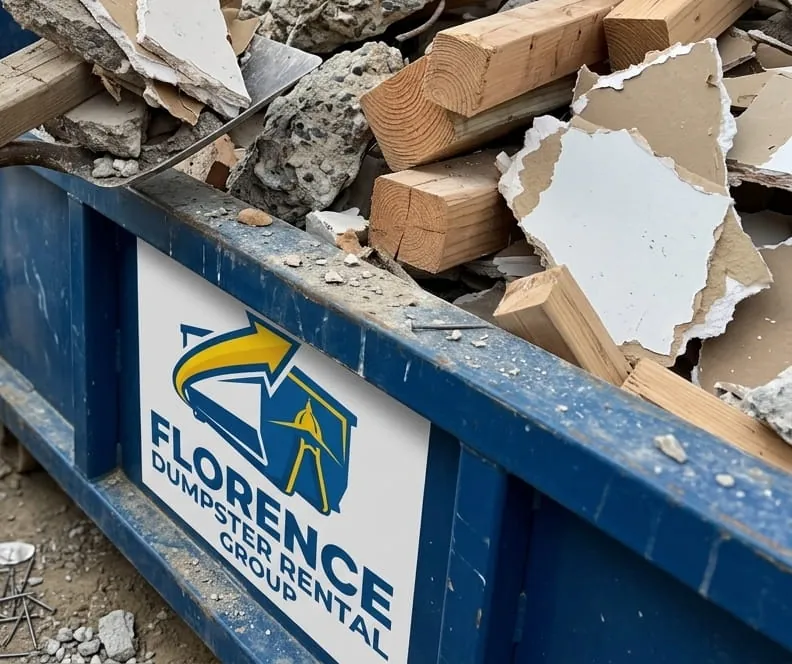
Framing, drywall, packaging and general build waste: go big. A 30 yard, with swap-outs planned into the programme. Bulky and light, so you fill the volume long before the weight allowance.
Concrete, block, brick and tile: go small. A 10 yard, filled between half and two-thirds. A cubic yard of concrete is around two tons.
Most real jobs need both at different phases, which is why we would rather talk through the programme than take a single order.
Practical site setup
- Place containers where the work is, not where they are convenient for the truck. Labour spent walking debris across a site is the largest hidden cost in waste handling.
- Label them. A sheet of plywood marked CONCRETE ONLY prevents a great deal of expensive contamination.
- Brief the trades. One subcontractor throwing a lunch bag into the clean concrete container costs more than the briefing would have.
- Book swaps into the programme, not on the day you notice the can is full.
- Watch the ground. North Alabama clay holds water. A site access route that carried a loaded truck in August will not necessarily carry one after a wet week in March.
- Cover heavy loads if rain is coming. You pay for that water by the ton.
We are happy to help set that up — tell us the build programme and we will schedule around the trade sequence.
Need a container in Florence?
Call and describe the job. Three minutes on the phone gets you a size recommendation, a flat rate and a delivery window — and we will tell you if a smaller, cheaper container is the right answer.
Call (938) 222-0137